


CHAI partners - contacts & FAQs
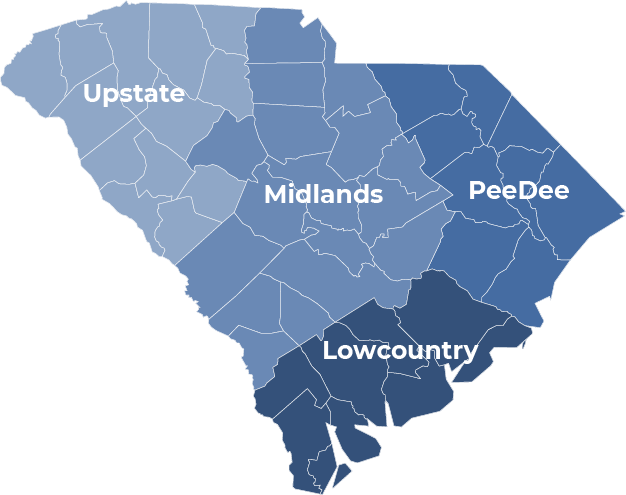
Midlands Regional Coordinator
Andrea Heyward
email Andrea
Tandem Health
Rural Health Services
Affinity Health Center
Community Medical Clinic of Kershaw County
Upstate
Regional Coordinator
Sarah Covington-Kolb
email Sarah
AccessHealth Spartanburg
Prisma Health
Greenville Free Medical Clinic
AnMed Access Health
ReGenesis Health Care
PeeDee
Regional Coordinator
Kim Rawlinson
email Kim
AccessHealth Horry
HopeHealth
Browns Ferry Community Outreach
McLeod Health
Darlington County First Steps
Lowcountry
Regional Coordinator
Alex Scott
email Alex
Roper St. Francis Healthcare
The Courage Center
PASOs
MUSC

Communications
Rich Strater
rstrater@email.sc.edu
Please contact Rich before publishing anything about CHAI on social media, in your organization’s newsletter, or any other form of external communications. You can download CCHA’s photo release form here.
Frequently Asked Questions
-
The majority of people that CHWs serve should be from the targeted zip codes, but these don’t have to be the only people they serve. We want to make sure CHWs are collecting which zip code the person is in.
-
CHAI is intended to support individuals without insurance or at risk of becoming uninsured. CHAI-funded CHWs should not turn those with insurance away. CHAI is targeting people without insurance and helping those with Medicaid or other insurance to enroll in a medical home and reduce their risk of becoming uninsured.
-
We are committed to a bold and equitable approach to expanding the CHW workforce in the Palmetto State by using our limited resources wisely. Our decision to fund the identified ZCTAs (Zip Code Tabulation Area) was data driven. There is a need to serve people in all of South Carolina’s 424 ZCTAs. However, we prioritized funding based on evidence-based inequities and are starting with the 40 highest need ZCTAs. Prioritizing these ZCTAs provides an opportunity to build on what we do in future years of this program and to garner additional resources to support more individuals in these identified communities in the years to come. This is only the beginning.
In some communities, there are significant income and health disparities. This means that CHAI may focus on communities that appear to be high-income, but also are home to low-income community members. To begin closing these gaps, we will take a closer look at health disparities in our state and embrace a more equitable approach to serving those that need the most assistance.
-
This funding is designated for serving the uninsured, so most of CHAI-funded CHWs’ participants should have no insurance. However, we understand that some insurance is inadequate, particularly for people with limited incomes. CHAI-funded CHWs may assist some underinsured participants, with the following stipulations:
The majority of people you serve are fully uninsured
None of the people you serve have Medicaid
The participant has indicated “Yes” on the question about being underinsured on the AZ Self Sufficiency Matrix (“In the past 12 months, has the participant ever avoided seeking medical care or treatment due to concerns about the cost, including not going to the doctor, skipping follow-up visits, or not filling a prescription?”)